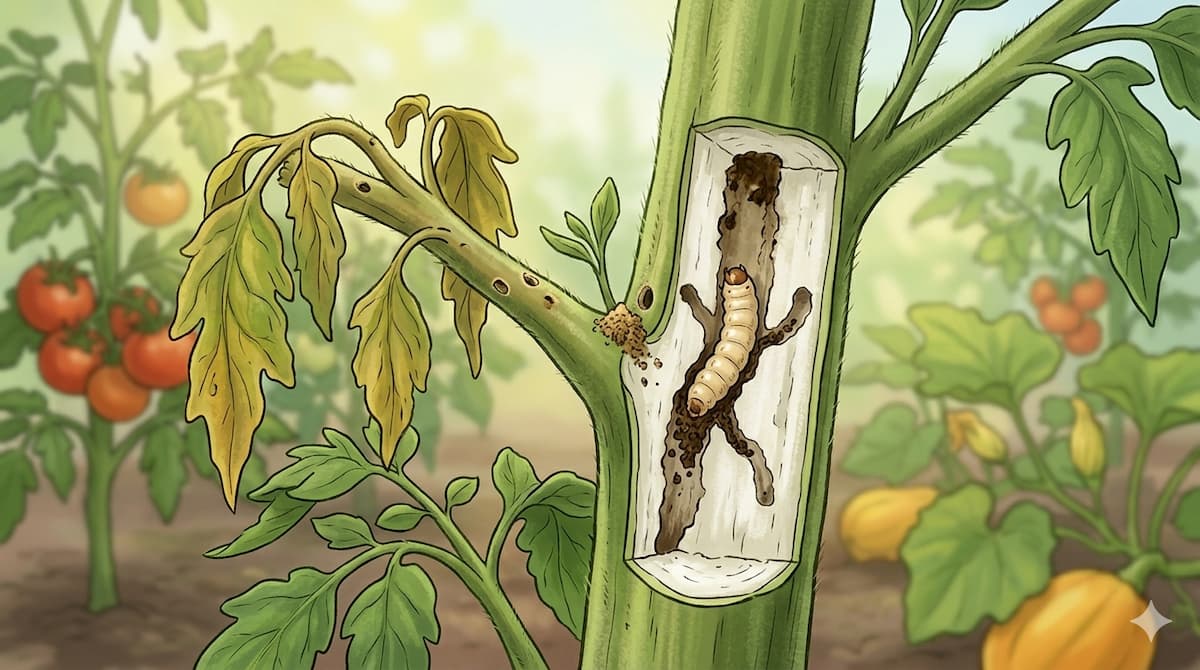
- If a healthy-looking plant suddenly wilts, breaks at the stem, or shows tiny holes with sawdust-like frass (frass = insect droppings + bore dust), you almost certainly have stem borers — larvae tunnelling inside your plant.
- Contact insecticides sprayed on the leaf surface cannot reach larvae protected by plant tissue. Only systemic insecticides — absorbed into the plant’s vascular sap — can expose hidden borers.
- Monocil 36% SL (Monocrotophos 36% SL) is a powerful systemic organophosphate used for stem borer control on authorised crops and ornamentals in India — but it is high-toxicity and requires strict safety protocols.
- Physical pruning and destruction of infested stems is the mandatory first step before any chemical treatment.
- Monitor for new entry holes and fresh frass every 7–10 days — early detection is the only cost-effective control strategy.
What Are Stem Borers and Why Are They So Hard to Control?
Stem borers are the larvae (caterpillars, grubs, or maggots depending on the parent insect species) of moths, beetles, or flies that complete part of their life cycle inside plant tissue. Unlike leaf-eating caterpillars or sap-sucking insects that live on the plant’s surface, stem borers exploit a nearly impenetrable refuge: the interior of a living stem.
Their life cycle follows a predictable sequence that explains both the damage pattern and the control challenge:
- Adult moths or beetles lay eggs on the plant surface — on leaves, at growing points, or in bark crevices.
- Eggs hatch into tiny larvae that initially feed on the surface for a brief period (sometimes only hours) before boring into the stem, midrib, petiole, or trunk.
- Once inside, the larva feeds on internal tissue — phloem, cambium, and pith — while growing, often for several weeks.
- The larva pupates inside the stem or exits to pupate in soil, and an adult emerges to restart the cycle.
The control problem is structural: once the larva is sealed inside plant tissue, it is completely shielded from surface-applied contact insecticides. The stem wall acts as physical armour. Only an insecticide that enters the plant itself — a systemic — can follow the larva into its tunnel through the plant’s own sap.
Which Plants Are Most Commonly Affected by Stem Borers in Indian Gardens?
Stem borers target a wide range of plants in Indian home and ornamental gardens. The specific species varies by region and season, but high-risk plants include:
| Plant Type | Common Borer Species | Part Attacked | Peak Risk Season |
|---|---|---|---|
| Ornamental shrubs & trees (hibiscus, rose, jasmine) | Clearwing moths (Synanthedon spp.), longhorn beetles | Main stems, branches | Monsoon and post-monsoon |
| Fruit trees (mango, guava, citrus, pomegranate) | Bark-eating caterpillar (Indarbela spp.), stem borer beetles | Trunk, primary branches | Summer and monsoon onset |
| Vegetables (chilli, brinjal, tomato) | Shoot & fruit borer (Leucinodes orbonalis) | Tender shoots, fruit | Year-round; peaks in humid conditions |
| Ornamental palms and bamboo | Red palm weevil (Rhynchophorus ferrugineus), bamboo borer | Crown, internodes | Summer |
| Curry leaf, drumstick (moringa) | Bark borer, web worm | Main stem, branches | Post-monsoon |
How Do You Identify Stem Borer Damage on Garden Plants?
Stem borer infestations are frequently misdiagnosed as fungal wilt, water stress, or bacterial disease — leading to incorrect treatment and wasted time. Here is the precise diagnostic sequence:
External Visual Signs
- Entry holes on stems or branches: Typically 1–5 mm in diameter, often with a slightly ragged or chewed edge. May be partially blocked with compacted frass.
- Frass accumulation: A distinctive sawdust-like mixture of bore dust, excrement, and chewed plant fibre. Appears at the entry hole or accumulates in a small pile at the base of the plant below the infested stem. Frass is the most reliable early indicator — check stem bases and branch forks regularly.
- Wilting or yellowing above the damage point: The larva disrupts the vascular tissue (xylem and phloem) inside the stem, cutting water and nutrient flow to everything above. The wilted section looks healthy except for the leaf droop.
- Easy stem breakage: A borer-hollowed stem has lost structural integrity. Affected stems snap or fold at the borer’s entry level under light pressure or wind.
Confirmatory Internal Check
- Select a wilting or suspicious stem and cut it longitudinally (lengthwise) with a clean blade.
- Inspect the pith (centre) of the stem. A borer-infested stem will show: a hollow gallery or tunnel, bore dust and frass inside the channel, and possibly the larva itself — a cream or yellowish grub or caterpillar.
- If the stem interior is clean and solid, look for other causes (fungal wilt, bacterial wilt, root rot).
Before reaching for any insecticide, confirm the diagnosis. Cut one affected stem lengthwise with a sharp blade. Presence of: (1) a hollow internal tunnel, (2) frass or bore dust inside, and (3) a visible grub = confirmed stem borer. Absence of all three = look for other causes first. This test takes 60 seconds and prevents costly misapplication of systemic insecticides to non-borer problems.
Why Do Contact Insecticides Fail Against Stem Borers?
This is the most critical concept for effective stem borer management: the physical location of the larva makes surface treatment strategies largely irrelevant once boring has occurred.
| Insecticide Type | How It Works | Why It Fails for Stem Borers | Effective Against Adult Stage? |
|---|---|---|---|
| Contact spray (pyrethroids: Lambda-Cyhalothrin, Cypermethrin) | Kills insects by direct skin/cuticle contact | Cannot penetrate plant stem wall to reach internal larvae | ✅ Yes — kills adults and newly hatched larvae before they bore in |
| Stomach poison (Chlorpyriphos 20% EC — Lethal) | Kills insects that eat treated plant surfaces | Larvae are eating internal plant tissue, not treated surfaces | ✅ Yes — at early larval stage before entry |
| Systemic insecticide (Monocrotophos 36% SL — Monocil; Dimethoate 30% EC — Tafgor) | Absorbed by plant; moves through vascular sap; kills insects feeding on treated sap anywhere in the plant | N/A — specifically designed to reach internal feeding insects | ✅ Yes — also effective against surface-feeding adults |
The practical implication: contact and stomach-poison applications are most valuable as preventive measures, applied before boring begins, to kill adults and newly-hatched larvae before they enter the stem. Once a larva is tunnelling inside, systemic action is required to reach it.
How Does Monocil 36% SL (Monocrotophos 36% SL) Work Against Stem Borers?
Monocil 36% SL contains Monocrotophos 36% SL (soluble liquid) — a systemic organophosphate insecticide that is among the most potent systemic options available for stem borer control in India. Its mechanism mirrors other organophosphates:
- Monocrotophos is absorbed through leaf and stem surfaces and moves systemically through the plant’s phloem.
- Stem borer larvae feeding on the internal phloem and cambium tissue ingest the active ingredient along with nutrients.
- Monocrotophos inhibits acetylcholinesterase in the larva’s nervous system — causing uncontrolled nerve signal firing, paralysis, and death within hours to 1–2 days of ingestion.
- Because the active ingredient is distributed throughout the plant’s sap system, larvae in any part of the stem are exposed when they feed — regardless of which specific tunnel they occupy.
Monocil 36% SL (Monocrotophos) is significantly more acutely toxic than Dimethoate or Chlorpyriphos. It is classified as a WHO Class Ib (Highly Hazardous) pesticide. Its use is restricted on many food crops in India, particularly vegetables and fruit near harvest. It is most appropriately used on non-edible ornamental trees and shrubs where access can be strictly controlled. If you are treating edible plants, confirm Monocrotophos is authorised for your specific crop and observe the pre-harvest interval on the label without exception.
When Is Monocil 36% SL Appropriate for Home and Ornamental Gardens?
Not every stem borer situation requires Monocrotophos. Use this decision framework to determine the right level of intervention:
| Situation | Recommended Action |
|---|---|
| 1–2 borer holes, small ornamental shrub, frass visible | Prune and destroy infested stems. Monitor × 2 weeks. No chemical needed yet. |
| Multiple holes, clear internal tunnelling, ornamental tree | Prune what you can, then apply Monocil 36% SL at label rate to remaining plant. |
| Trunk borer on large ornamental/fruit tree | Monocil foliar spray + targeted injection into entry holes with a syringe (where label allows). Consider professional pest control for large trees. |
| Borer on edible vegetable (chilli, brinjal shoot borer) | Check if Monocrotophos is registered for that crop. If not authorised, use a registered alternative like Dimethoate 30% EC (TATA Tafgor) at label rate during vegetative stage only. |
| Borer on edible fruit tree near harvest | Do not use high-toxicity systemics. Prune and destroy. Consult a professional for integrated management. |
Step-by-Step Stem Borer Treatment Protocol for Home Gardens
-
Diagnose and confirm.
Cut one wilting stem lengthwise. Confirm the presence of an internal tunnel, frass, and/or a larva before proceeding. Do not apply systemic insecticides if the diagnosis is uncertain. -
Prune and immediately destroy all heavily infested stems.
Use clean, sharp pruning shears. Cut back to healthy, uninfested tissue — at least 5 cm below the last visible frass or tunnel. Seal all cut stems in a plastic bag immediately and dispose away from the garden. Do not leave cut infested material on the ground — larvae can exit and re-bore. -
Disinfect pruning tools between cuts.
Dip shears in a 10% bleach solution between each cut to prevent spreading any bacterial pathogens that may be secondary to borer wounds. -
Mix and apply systemic insecticide.
For ornamental plants: mix Monocil 36% SL (Monocrotophos) at the label-recommended dose in water. Apply as a thorough foliar spray covering stems, branches, and leaves. For larger borer holes in thick stems or tree trunks, a small volume of diluted solution can be injected directly into the entry hole using a large-bore syringe — only when the label permits this application method. -
Apply at the right time of day.
Spray in early morning (before 9 AM) or evening (after 5 PM). Systemics require leaf absorption — avoid spraying in direct midday sun or before expected rain. -
Inspect at 7–10 days for fresh frass.
New frass at entry holes indicates surviving or newly-emerged borers. Repeat treatment once within label-specified maximum applications per season. -
Monitor monthly thereafter.
Check stem bases, branch forks, and trunk surfaces for new entry holes. A monthly 5-minute inspection prevents reinfestation from escalating to a treatment-requiring level.
Buy TATA Tafgor (Dimethoate 30% EC) — Systemic for authorised vegetable crops
How to Prevent Stem Borers from Infesting Your Garden Plants
Preventing borer entry is far more effective than treating an established infestation. Once a larva is tunnelling inside a thick stem or trunk, even systemic treatment has limits — and the structural damage to the plant cannot be undone.
- Preventive systemic sprays during high-risk seasons: Apply a systemic insecticide (Dimethoate 30% EC or approved product for your crop) during the period when adult moths and beetles are laying eggs — typically at monsoon onset and early post-monsoon. This kills newly-hatched larvae before they bore in.
- Seal pruning wounds immediately: Fresh cut branches are attractive entry points for adult stem borers. Apply a copper-based wound paste or Bordeaux paste immediately after pruning to seal the wound and deter egg-laying at cut surfaces.
- Maintain plant vigour: Stressed, drought-weakened plants emit volatile compounds (ethylene, terpenes) that attract bark beetles and stem borers. Keep plants well-watered (not waterlogged) and nutritionally balanced — a health plant is less attractive and better able to resist larval penetration.
- Remove dead wood promptly: Dead branches are preferred oviposition (egg-laying) sites for many stem borer species. Cut and remove dead wood as soon as it appears rather than leaving it on the plant.
- Inspect nursery plants before purchase: Stem borers can be introduced on newly purchased plants, especially container-grown ornamental trees. Check stems and trunks for entry holes and frass before bringing any new plant into your garden.
Safety Protocols for Monocil 36% SL and High-Toxicity Systemics
- WHO Classification: Monocrotophos is classified as Class Ib — Highly Hazardous. Treat it with significantly higher caution than Dimethoate or Lambda-Cyhalothrin.
- Full PPE is mandatory: Chemical-resistant rubber gloves (not nitrile alone), a full-face respirator (not just a dust mask), safety goggles, a chemical-resistant apron or full Tyvek suit, long sleeves, full-length trousers, and rubber boots. No shortcuts on PPE with Monocrotophos.
- Ventilation: Mix and apply only in open areas. Keep upwind at all times. Never spray in enclosed or semi-enclosed spaces even with ventilation.
- Children, pets, and livestock: Remove completely from the area before application. Do not allow re-entry for a minimum of 72 hours or until confirmed dry. Monocrotophos is acutely toxic to mammals, birds, and beneficial insects.
- Crop restriction: Monocrotophos use is restricted or prohibited on many food crops, especially vegetables, in India. Never use on crops where it is not registered. If uncertain, use Dimethoate 30% EC (TATA Tafgor) as a less toxic alternative for authorised crops.
- Water body and aquatic safety: Monocrotophos is highly toxic to fish and aquatic life. Do not spray near ponds, streams, open drains, or rainwater collection. Keep a minimum 10-metre exclusion zone from all water bodies.
- Emergency: In case of accidental ingestion or severe exposure, call the National Poison Information Centre (AIIMS): 1800-11-6117 (toll-free). Take the original product label to the hospital — the specific active ingredient name is required for treatment. Atropine sulphate is the antidote for organophosphate poisoning — only administered medically.
- Professional alternative: If you are not comfortable handling Class Ib pesticides yourself, consider engaging a licensed pest control professional, especially for large tree borers or severe ornamental infestations.
Frequently Asked Questions About Stem Borers in Indian Gardens
How do I know if my plant has stem borers or bacterial wilt?
Both cause sudden wilting, but the tell-tale difference is frass and entry holes. Bacterial wilt (Ralstonia solanacearum) shows stem ooze when a cut stem is placed in water (milky thread-like streams). Stem borers show a hollow internal tunnel with bore dust and frass when the stem is cut open. No ooze in clear water, but hollow interior = stem borer. Milky ooze in water = bacterial wilt. These two problems require completely different treatments.
Can I use Dimethoate (TATA Tafgor) instead of Monocrotophos for stem borers?
Yes, for authorised crops and moderately severe infestations. Dimethoate 30% EC (TATA Tafgor) is a systemic organophosphate that moves through plant sap and kills stem borer larvae when they feed. It is less acutely toxic than Monocrotophos (WHO Class II vs Class Ib) and more broadly registered for food crops. For lighter borer infestations on vegetables or fruit trees within the registered use scope, Dimethoate is often the more appropriate choice. Monocrotophos is reserved for severe infestations on ornamentals where its higher systemic potency is needed.
What is frass and why does it matter for stem borer diagnosis?
Frass is the by-product of a stem borer larva’s internal feeding — a mix of chewed plant fibre, excrement, and bore dust ejected from the tunnel through the entry hole. Its appearance is like fine sawdust or coffee grounds, sometimes mixed with dark pellets. Frass is significant because it is the earliest visible external sign of borer activity — often appearing before any wilting or structural damage is visible. Regular inspection of stem bases and branch forks for frass is the most effective early detection method.
My large mango tree has stem borers — can I treat it myself?
For large fruit trees with extensive borer infestations in the trunk or primary branches, professional pest control is strongly recommended. Home-garden hand sprayers cannot achieve the application volume needed for full systemic coverage of a large tree. Additionally, tall tree application creates significant personal exposure risk. A licensed pest control professional has access to high-volume sprayers, canopy application equipment, and the appropriate personal protective equipment for high-toxicity systemic treatments on large trees.
How do I prevent borers from attacking my plants next season?
The most effective prevention is timed systemic sprays during adult moth/beetle egg-laying periods — typically at monsoon onset (June–July) and again in October-November across most of India. Apply Dimethoate 30% EC (Tafgor) or another registered systemic at label rate to your high-risk plants during these windows. Additionally: seal all pruning wounds with copper paste, remove dead wood promptly, maintain plant vigour through balanced watering and fertilisation, and inspect stem bases monthly for early frass signs.
Conclusion: See the Signs Early, Act from the Inside Out
Stem borers are among the most frustrating pests in Indian home gardens precisely because their damage is largely invisible until it is severe. A plant can look completely healthy from the outside while a larva systematically dismantles its vascular system from within — and then appear to collapse overnight with no apparent cause.
The keys to successful management are: recognising frass and entry holes before structural damage occurs, confirming the diagnosis with a stem cut before any chemical application, removing infested material physically and immediately, and then — for persistent or severe infestations on non-edible ornamentals — applying a true systemic insecticide like Monocil 36% SL (Monocrotophos 36% SL) that follows the larva into its protected tunnel through the plant’s own sap. For food crop applications within the registered scope, TATA Tafgor (Dimethoate 30% EC) provides systemic action with a better safety profile for use around edible plants.