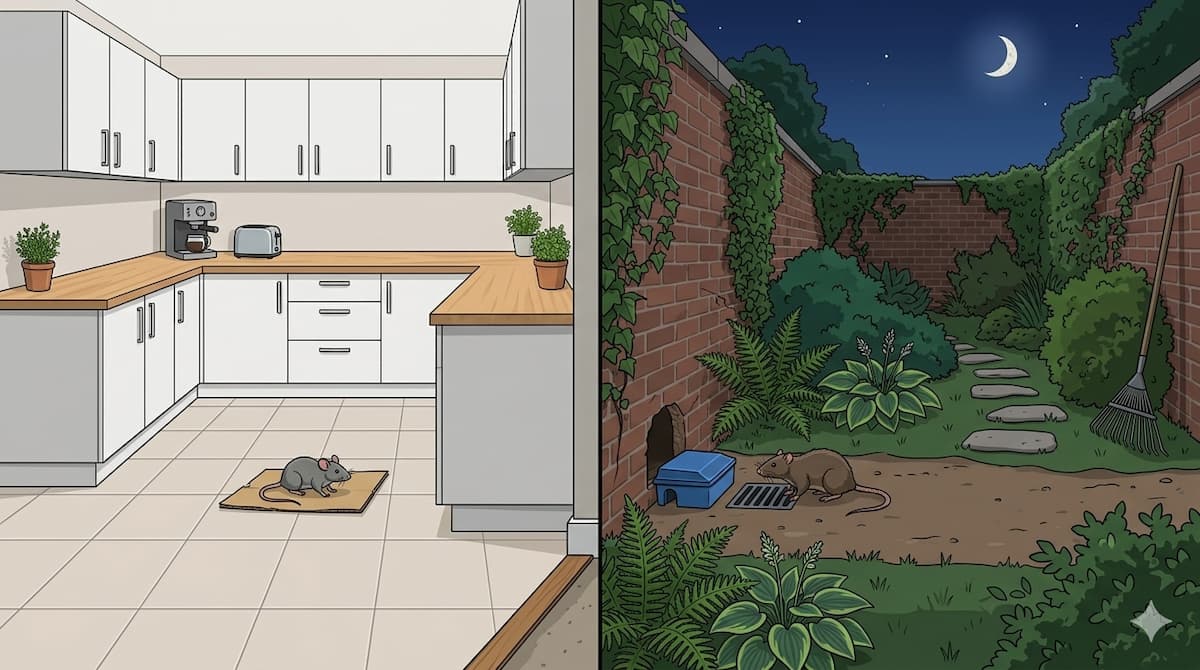
TL;DR: When exactly should you deploy glue traps versus chemical poison baits?
For aggressive rats and mice infiltrating Indian homes, non-toxic glue traps like PCI Trubble Gum are the absolute smartest choice for indoor deployment—they provide immediate visual proof of capture and eliminate the severe risk of secondary poisoning to children or indoor pets. Conversely, highly aggressive outdoor poison baits like the zinc phosphide-based UPL Ratol are vastly superior for defending exterior perimeters, agricultural terraces, and deep open drains where mass populations breed, ensuring dead rodents do not decay inside your interior walls.
Why do rodents constantly keep returning to your home even after you kill a few?
Physically killing a single foraging rat or trapping an isolated mouse rarely solves a structural infestation. Rodents, specifically the Indian roof rat (Rattus rattus) and the common house mouse (Mus musculus), are biologically highly adaptable survivors:
- Pheromone Trails: They religiously follow the exact same established, scent-marked routes every single night, physically hugging baseboards and dark edges.
- Neophobia (Fear of New Things): Mature rats possess a severe innate biological fear of newly placed objects in their environment, allowing them to easily avoid poorly placed, obvious traps.
- Continuous Infiltration: As long as external physical breaches exist—such as broken AC exhaust vents, uncapped plumbing drains, or 1/4-inch gaps under exterior doors—new rodents will continuously migrate inward to replace the dead ones.
Therefore, randomly placing a trap in the middle of a room is mathematically doomed to fail. You fundamentally require a holistic, strategic approach that actively intercepts their heavily traveled biological pathways while systematically hardening your building’s physical envelope.
How do rats and mice behaviorally move inside modern Indian homes?
Understanding the strict, predictable physical movement patterns of urban rodents is the absolute prerequisite to successful trapping. They do not casually wander; they calculate risk.
- The Thigmotaxis Principle: Rodents strongly prefer to run with one side of their physical body brushing directly against a solid wall rather than exposing themselves across open, illuminated floor spaces.
- The Indoor Highways: They exclusively utilize the dark, entirely undisturbed physical space directly behind heavy refrigerators, deep underneath enclosed modular kitchen cabinets, and constantly run along continuous wooden skirting boards.
- The Prime Entry Points: They actively exploit the absolute smallest physical construction failures—chewing through plastic drain pipes, bypassing broken mesh window screens, and squeezing under poorly fitted wooden doors.
When is it strategically best to use a glue pad trap like PCI Trubble Gum?
Commercial glue traps are heavy, flat cardboard or plastic boards thickly coated with a highly aggressive, non-drying industrial adhesive. When a rodent attempts to rapidly cross the board, it becomes instantly and permanently immobilized.
Buy PCI Trubble Gum (Rat trap)
The Optimal Operational Use Cases for Glue Traps:
- Strictly Indoor Environments: Perfectly suited for sensitive residential kitchens, isolated indoor storerooms, and highly trafficked family living areas.
- High-Risk Safety Households: The mandatory choice for homes actively containing young crawling children, roaming dogs, or indoor cats, precisely where deploying neurotoxic chemical baits represents an unacceptable lethal hazard.
- Requiring Visual Confirmation: When you absolutely must have immediate, undeniable physical proof that the specific active rodent has been successfully captured and removed from the property.
Crucial Glue Trap Limitation: Glue traps inherently fail in highly dusty environments (like open basements or active construction zones) or extremely wet locations (like directly inside a dripping sink cabinet), as heavy airborne dust and pooled water instantly neutralize the sticky industrial adhesive.
When is it strategically best to deploy rodent poison bait like UPL Ratol?
Agricultural-grade poison baits, such as the highly potent UPL Ratol, are specifically chemically engineered to be highly palatable, actively encouraging mass ingestion by a massive foraging rat population.
The Optimal Operational Use Cases for Chemical Baits:
- Exterior Defense Perimeters: The absolute best tool for heavily targeting deep municipal drains, exterior garbage accumulation zones, and exposed perimeter boundary walls.
- Large Uninhabited Structures: Highly effective in massive agricultural godowns, rarely accessed open terraces, dark internal lofts, and isolated exterior farm sheds.
- High Population Density: When the mathematical scale of the outdoor infestation exceeds the physical operational capacity to manually check dozens of individual daily glue traps.
Comparison Matrix: Glue Traps versus Chemical Poison Baits
| Eradication Method | Optimal Deployment Zone | Primary Operational Advantages | Critical Operational Disadvantages |
|---|---|---|---|
| PCI Trubble Gum (Glue) | Strictly Inside (Kitchens, Rooms) | 100% Non-toxic; provides immediate visual proof; drastically safer for household pets. | Fails in dust/water; requires meticulous wall-edge placement; demands frequent manual checking. |
| UPL Ratol (Poison) | Strictly Outside (Drains, Yards) | Capable of decimating massive populations; demands far less daily physical monitoring. | Severe secondary toxicity risk to non-target pets; rats may decay silently inside inaccessible wall voids. |
Where exactly should you place PCI Trubble Gum to guarantee a catch?
To successfully capture a rat, you must treat your home’s floor plan exactly like a highly predictable rodent highway map. Placement is exponentially more critical than the physical stickiness of the trap itself.
- Total Fridge Encapsulation: Pull the heavy refrigerator out 2 inches. Place the glue pad flush, absolutely flat against the back wall so the foraging rat must directly step onto the pad while attempting to navigate the narrow, warm channel created by the compressor heat.
- The Under-Sink Choke Point: Completely clear out the dark under-sink cabinet. Place the pad tightly jammed into the absolute rear corners, directly adjacent to the exact point where the dark PVC plumbing physically breaches the wall or floor.
- Perpendicular Doorway Blocking: If a rat is known to squeeze under a specific interior door, place the long edge of the trap tightly and perpendicularly against the wall immediately beside the door frame, effectively blocking the expected turning exit route.
Essential Safety & Utilization Protocols for Rodent Management:
- Chemical Bail Handling: You must mandatorily wear thick, disposable nitrile gloves whenever physically handling UPL Ratol or any chemical bait block to prevent unintentional biological skin absorption and to prevent transferring human scent onto the bait itself.
- Bait Station Mandate: Never casually throw loose chemical poison directly onto open ground or bare countertops. Chemical baits must rigorously be locked inside heavy, tamper-resistant black plastic bait stations if deployed anywhere remotely near roaming household pets or local wildlife.
- Safe Glue Disposal: When utilizing PCI Trubble Gum, always wear gloves to physically retrieve the captured live rodent. Fold the heavy cardboard trap aggressively over itself to fully encompass the animal, place it securely inside a thick, heavy-duty black garbage bag, tie tightly, and execute immediate exterior disposal in accordance with strict local municipal sanitation laws.
- Accidental Pet Encounters: If a household pet accidentally strongly adheres to a Trubble Gum pad, do not violently pull. Liberally apply standard liquid cooking oil (vegetable or olive oil) directly to the adhesive bond to gently and safely dissolve the industrial glue from the animal’s fur.
Summary: Executing a holistic rat management masterplan
Eliminating rodents permanently requires an integrated dual-pronged strategy, not a single miracle product:
- Aggressively map the physical perimeter: Identify all fresh droppings, hard greasy smudge marks on baseboards, and active chewing damage.
- Secure the interior envelope: Deploy non-toxic PCI Trubble Gum strategically flat against the interior baseboards explicitly behind all heat-generating kitchen appliances.
- Defend the exterior perimeter: Responsibly deploy localized bait stations filled with UPL Ratol specifically near deep exterior drains and identified dense outdoor nesting areas.
- Execute permanent exclusion: Physically mandate sealing all identifying exterior wall gaps, installing heavy steel mesh over active drain outlets, and adding tight rubber weather-sweeps under all exterior doors.