TL;DR: How to catch and stop destructive termites early
Subterranean termites frequently invade Indian homes and visually manifest as brown mud tubes, fine sawdust debris, and hollow-sounding wood. To aggressively protect expensive wooden doors, custom furniture, and concrete foundations, you must correctly identify whether the attack is localized (treatable by a homeowner) or structurally widespread (requiring professional exterminators). High-strength chemical termiticides like Lethal 20% EC (Chlorpyriphos) are the absolute agricultural standard for creating successful soil and wood-contact barriers when utilized with strict PPE safety protocols.
How do you know if you currently have termites inside your home?
Termites are infamous “silent destroyers” because they deliberately stay hidden deep within structural wood until catastrophic physical damage has already occurred. However, you can identify an active infestation by looking for four critical, undeniable warning signs:
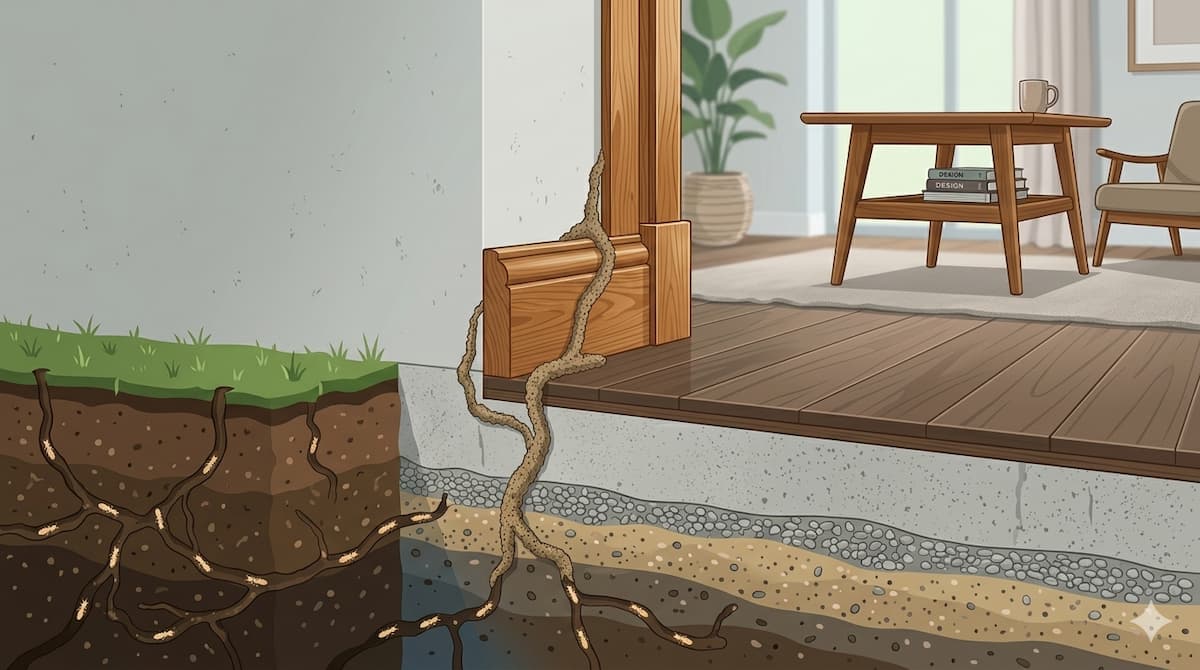
- Mud Tubes (Galleries): Pencil-thin, dried brown mud tunnels physically constructed on exterior walls, concrete foundations, or climbing up wooden furniture legs to protect foraging termites from light and dry air.
- Hollow-Sounding Wood: Firmly tap your wooden door frames, baseboards, and heavy furniture with a hard tool. A distinct, papery, hollow sound strongly indicates severe internal cellulose excavation by a hidden termite colony.
- Swarmers (Alates): Hundreds of winged, reproductive termites suddenly emerging from baseboard cracks, almost exclusively during the humid Indian monsoon, swarming frantically around indoor light fixtures.
- Wood Dust (Frass): Small, unexplained piles of fine, granular, sawdust-like fecal pellets distinctly accumulating directly beneath wooden items or small pinpoint exit holes.
Environmental Fact: These specific visual signs are mostly prevalent in Indian homes immediately during and after the heavy monsoon season, primarily isolated at ground level or exactly where wooden framing physically contacts moist masonry or raw soil.
What is the difference between pre-construction and post-construction termite treatment?
There are two entirely different methodological approaches to defending a brick-and-mortar structure against subterranean termites:
1. Pre-Construction Termite Treatment
This proactive methodology is executed exclusively before a new building’s foundation is poured and finished:
- The bare soil directly below and surrounding the external foundation trenches is heavily saturated with an organophosphate termiticide like Chlorpyriphos.
- This establishes an unbroken, highly toxic, continuous chemical barrier that soil-foraging termites fundamentally cannot cross.
- It is universally considered the most effective, permanent, and long-lasting form of structural termite protection available.
2. Post-Construction Termite Treatment
This reactive methodology is executed after you are already actively living inside the completed building (the situation for 95% of homeowners):
- Deep holes are mechanically drilled continuously around the entire structural perimeter (both inside and outside), and chemical termiticide is aggressively injected under high pressure deep into the soil directly next to the foundation wall.
- Highly vulnerable wooden elements, particularly ground-floor door frames and window sashes, are also physically drilled and chemically injected.
- While substantially more labor-intensive and potentially less uniform than pre-construction methods, it acts as a highly effective critical intervention.
When can homeowners self-treat termites, and when should they hire professionals?
Chemical termiticides are highly toxic, and deciding whether to DIY or hire an expert depends solely on the mathematical scale of the termite infestation.
| Treatment Scenario | Key Required Indicators | Recommended Action |
|---|---|---|
| Localized / Early Attack | Infestation is strictly limited to 1-2 distinct wooden items (e.g., a single door frame). Mud tubes are highly localized, physically small, and recently built. | DIY Spot Treatment (Utilizing Chlorpyriphos with strict PPE compliance). |
| Widespread / Structural Attack | Multiple mud tubes across diverse interior walls or traversing multiple floors. Core structural beams or widespread furniture sounds deeply hollow. Visible swarms of winged termites indoors. | Hire Professional Pest Control (Requires specialized high-pressure drilling and injection equipment). |
Why is Lethal 20% EC (Chlorpyriphos) widely utilized against termites?
Lethal 20% EC contains the active ingredient Chlorpyriphos, a historically well-known, highly potent, broad-spectrum organophosphate insecticide and termiticide.
- It physically excels as a deep soil-drenching chemical applied directly around structural masonry foundations to create a lethal subterranean barrier.
- It serves dual duty and can be explicitly formulated to spot-treat dense wood that remains in direct physical contact with concrete masonry or raw soil.
- It inherently possesses a notoriously harsh, strong chemical odor, which acts as a built-in safety mechanism, making it immediately obvious exactly when and where the active chemical has been applied inside a home.
Buy Lethal Chlorpyriphos 20% EC
How do you correctly dilute and apply Lethal 20% EC for termites?
Mandatory Disclaimer: You must always read and explicitly follow the specific chemical label on your purchased pack. The technical guidelines below are standard industry practices but the manufacturer’s label is the ultimate legal authority.
Procedure 1: Soil Drenching Around Heavy Foundations
Objective: To create an unbroken, lethal chemical subterranean barrier stopping termites from traveling upward from the soil.
- Physically dig a narrow continuous trench (approximately 15–30 cm deep) directly along the exterior wall exactly where the termites are visibly entering the structure.
- Carefully mix the officially recommended volume of Lethal 20% EC into clean water (a standard agricultural baseline is often 20-25 ml per 1 litre of water; verify this on your specific bottle).
- Slowly and evenly pour the highly diluted chemical solution continuously along the open trench, ensuring the exposed sub-soil becomes heavily saturated.
- Immediately backfill and firmly tamp the trench with the chemically treated, excavated soil to seal the barrier.
Procedure 2: Spot-Treating Door Frames and Wooden Members
Objective: To aggressively chemically stop termites traveling internally upward through wood that touches raw masonry or concrete floors.
- Use a power drill to bore small, angled 45-degree downward holes into the lower 12 inches of the wooden door frame or vulnerable wooden member.
- Utilize a specialized chemical syringe or a tiny focused funnel to persistently inject the diluted Chlorpyriphos solution deep into each drilled hole until the internal wood matrix is completely chemically saturated.
- Once fully dried, permanently seal the open drill holes with standard wood putty or chemical resin.
- Critically, you must also heavily treat the immediate adjacent soil or concrete cracks precisely at the base where the wooden frame physically touches the floor.
Essential Chlorpyriphos Home Safety Protocols:
- Lethal 20% EC is an aggressive technical-grade agricultural product, absolutely not a casual household aerosol spray.
- Mandatory PPE: You must always wear thick, chemically-resistant nitrile gloves, an activated-charcoal respirator mask, and protective splashing safety goggles during mixing and application.
- Absolute Isolation: Do not allow children, pregnant women, or household pets within 50 feet of the treated areas until all wet chemical surfaces have completely physically dried and the harsh organophosphate odor has thoroughly dissipated through physical cross-ventilation.
- Exposure Protocols: Strictly avoid any bare skin contact; if incidental contact occurs, aggressively wash the area immediately with harsh soap and massive volumes of flowing cold water. Never eat, drink, or smoke while handling organophosphates.
- Storage: Store the tightly sealed concentrated chemical bottle in a highly secure, physically locked location utterly isolated from all human food, medical supplies, and localized water sources.
What are the best natural and preventive ways to reduce indoor termite risk?
Applied chemical termiticides are exponentially more successful when intelligently combined with preventative structural building and physical furniture practices:
- Always maintain physical air gaps—keep heavy wooden furniture completely pulled away from direct resting contact against damp interior masonry walls and wet concrete floors.
- Immediately hire plumbers to fix active internal pipe leaks and poor exterior drainage pooling that systemically keeps lower walls and sub-floors chronically damp.
- Absolutely avoid stacking raw, untreated wooden planks or wet cardboard boxes directly on floors inside dark, unventilated basements or closed ground-floor storerooms.
- Only construct new interior furniture using chemically pressure-treated, adequately kiln-seasoned hardwood.
Summary: A practical, professional plan to protect your home from termites
- Vigilantly Inspect: Routinely check baseboards and hidden corners for definitive mud tubes, structurally hollow wood, and unexplained fine sawdust.
- Diagnose the structural scale: Honestly access if this is a minor, local surface issue versus a widespread, deeply embedded structural disaster.
- Deploy Targeted Chemicals: Responsibly utilize Lethal 20% EC (Chlorpyriphos) for aggressive local soil and wood-injection treatments, strictly following required PPE safety mandates.
- Defer to Experts: Immediately contract professional, licensed exterminators for any large-scale, multi-room, or chronically repeated subterranean infestations.
- Harden the Structure: Permanently strengthen the physical envelope of your building by installing vastly superior exterior water drainage, upgrading to pre-treated wood, and systematically eliminating all direct wood-to-soil contact.