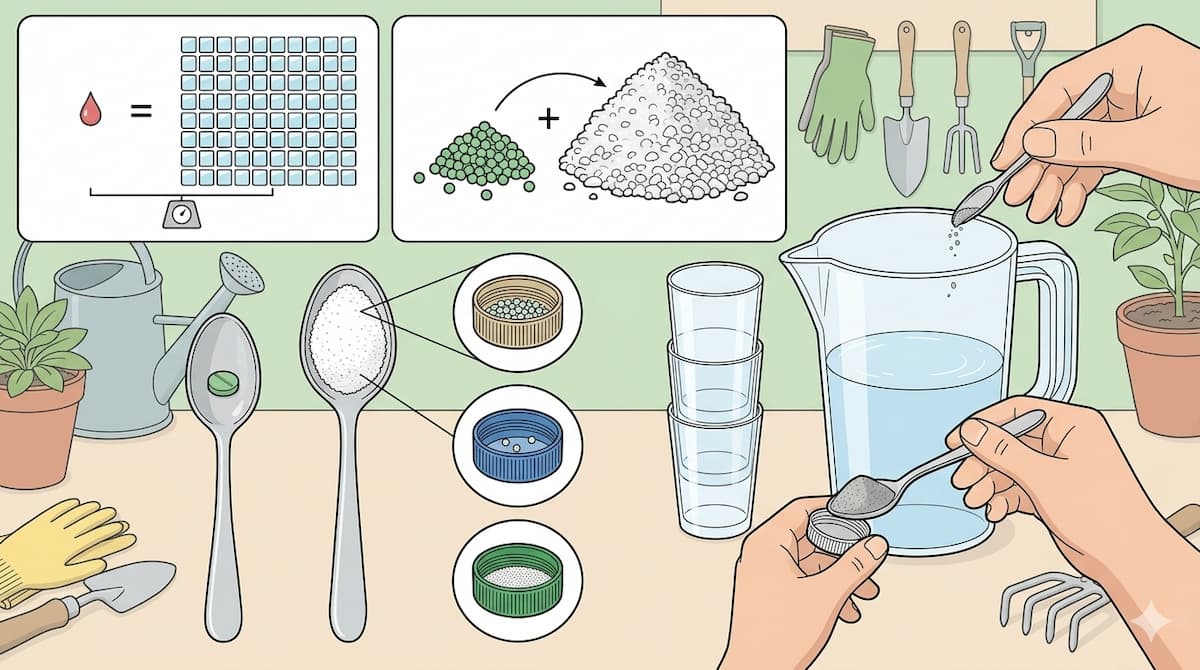
- Most home garden pesticides are dosed at 1–2 ml per litre (liquids like Dimethoate, Chlorpyriphos EC) or 1–2 g per litre (powders like Mancozeb WP, Carbendazim).
- The most accurate low-cost tool is a 5 ml disposable syringe (no needle, available at any pharmacy for ₹10–30). Draw to the 2 ml graduation mark — done.
- For powders, use a digital kitchen scale once to calibrate a dedicated spoon — then use that spoon as your reference every time.
- Never guess by eye. Overdosing burns leaves (phytotoxicity) and increases health risk. Underdosing fails to control pests and builds chemical resistance.
- Keep all measuring tools labelled “Pesticide Use Only” and stored with your garden chemicals — never in the kitchen.
Why Does Accurate Pesticide Measurement Matter for a Home Garden?
When a pesticide label says “2 ml per litre”, that number is the result of field trials, toxicology studies, and regulatory review. It is the dose that controls the target pest — no more, no less. Deviating from it has two equally harmful outcomes:
- Underdosing: The active ingredient concentration is too low to kill the target pest effectively. Survivors are exposed to sub-lethal doses — the exact condition that accelerates resistance development. You will find yourself spraying more often, spending more money, and getting progressively worse results. This is how resistant populations of pests develop in home gardens.
- Overdosing: Excess active ingredient causes phytotoxicity — chemical burn damage to leaves appearing as brown tips, scorched patches, yellow margins, or complete leaf death. For edible crops, overdosing extends the residue presence beyond the safe pre-harvest interval (PHI), meaning you cannot safely eat the produce on schedule. For the gardener, higher concentrations mean higher personal exposure during mixing and spraying.
The good news: achieving an accurate 2 ml/L measurement does not require a calibrated measuring cylinder or a lab scale. It requires only a ₹20 pharmacist purchase and this guide.
How to Measure 2 ml Per Litre Using a 5 ml Syringe
A 5 ml disposable syringe without a needle is the most accurate, cheapest, and easiest measuring tool available to home gardeners. It is available at every pharmacy and medical supply shop in India, costs ₹10–30 per pack of 5, and has clear graduation markings in 0.2 ml increments — more precise than any household spoon or cap.
Step-by-Step: Measuring Liquid Pesticides with a Syringe
- Put on gloves before handling the pesticide bottle.
- Hold the syringe vertically with the tip pointing up. Draw back the plunger slightly to confirm it moves freely.
- Insert the syringe tip into the liquid in the product bottle (or use a small pouring cap if the bottle opening is wide).
- Draw the plunger back slowly until the liquid level in the syringe reaches the 2 ml graduation line — the second mark from the tip on a standard 5 ml syringe.
- Hold it to eye level and check — the bottom of the liquid meniscus (the curved surface) should sit exactly on the 2 ml line.
- Transfer the measured volume into a mixing bucket or half-filled sprayer tank.
- Rinse the syringe immediately after use with clean water. Store separately from medical/food use items — labelled “Pesticide Use Only”.
| Tank/Bottle Size | Water Volume | Dose at 1 ml/L | Dose at 2 ml/L | Syringe Draws (5 ml) |
|---|---|---|---|---|
| Hand pump sprayer | 1 litre | 1 ml | 2 ml | Draw to 2 ml mark once |
| Small garden sprayer | 2 litres | 2 ml | 4 ml | Draw to 2 ml mark twice |
| Medium sprayer | 5 litres | 5 ml | 10 ml | Two full 5 ml draws |
| Knapsack sprayer | 15 litres | 15 ml | 30 ml | Six full 5 ml draws |
How to Measure Pesticide Using a Bottle Cap (Without a Syringe)
If you do not have a syringe immediately available, a clean plastic bottle cap is the next best option. The key step is calibrating it once using a known reference.
Step-by-Step: Calibrate and Use a Bottle Cap
- Select a clean, dry plastic cap — from a 1-litre water bottle (typically holds 5 ml when filled level) or a soft drink bottle.
- One-time calibration: Fill the cap with clean water, level it off, then pour into a measuring syringe or marked glass. Note how many ml the cap holds when level. Write this on the cap with a permanent marker (e.g., “CAP = 4 ml”).
- For a 2 ml dose from a 4 ml cap: fill the cap to the halfway mark.
- For a 2 ml dose from a 5 ml cap: fill to just below the halfway mark — approximately 40% full.
- Pour the measured cap volume into the mixing tank. Rinse cap with the tank water immediately.
The bottle cap method introduces a ±0.5 ml error margin at 2 ml — a 25% deviation either way. This is acceptable for ornamental plants where exact dosing is less critical, but not recommended for edible crops where PHI compliance requires consistent, precise dosing. For chilli, tomato, lemon, or any crop you consume — invest in a syringe.
How to Measure 2 g Per Litre for Powder Pesticides (Mancozeb, SAAF, Plantomycin)
Wettable powder (WP), soluble powder (SP), and water-dispersible granule (WG) formulations — like Indofil M-45 (Mancozeb 75% WP), UPL SAAF (Carbendazim 12% + Mancozeb 63% WP), and Aries Plantomycin (Streptomycin + Tetracycline) — are dosed by weight in grams, not volume in ml. Scooping a teaspoon looks consistent but is wildly variable because powder density changes with how the tin was stored, packed, or settled.
The One-Time Spoon Calibration Method
- Borrow or purchase a small digital kitchen scale that reads to 0.1 g accuracy (available for ₹300–600 online).
- Place a clean, dry spoon on the scale and zero/tare the scale so it reads 0.0 g.
- Add the specific powder (e.g., Mancozeb 75% WP from Indofil M-45) to the spoon — gently, tap the spoon to settle it — until the scale reads exactly 2.0 g.
- Observe carefully: is the spoon heaped, level, or partly full? Note what it looks like with a written description (e.g., “level quarter teaspoon for Mancozeb”) or take a photograph.
- Use this visual reference every time you mix that specific product — the same powder, same spoon, same fill level = approximately 2 g.
- Repeat this calibration for each different powder product — densities vary significantly between Mancozeb, Carbendazim, Copper Oxychloride, and Streptomycin formulations.
A level teaspoon of fine-ground Mancozeb 75% WP weighs approximately 2–2.5 g. But a level teaspoon of coarser-ground Copper Oxychloride 50% WP (like in TATA Blitox) may weigh 3–4 g — a 50–100% overdose using the same spoon and “fill level”. Always calibrate each product independently with a scale. Never assume “one teaspoon = 2 g” across all powders.
Complete Measurement Method Comparison: Which Tool to Use When
| Tool | Best For | 2 ml dose | 2 g dose (powder) | Cost | Accuracy |
|---|---|---|---|---|---|
| 5 ml syringe (no needle) | All liquid EC/SL products | Draw to 2 ml graduation mark | Not applicable | ₹10–30 per pack | ⭐⭐⭐⭐⭐ Best |
| Digital scale | All powder WP/SP/WG products | Not applicable | Weigh directly to 2.0 g | ₹300–600 | ⭐⭐⭐⭐⭐ Best |
| Calibrated bottle cap | Liquids when no syringe available | Half of a calibrated 4 ml cap | Not recommended | Free (reused) | ⭐⭐⭐ ±25% error |
| Calibrated spoon | Powders when no scale available | Not recommended | Use scale once to set reference | Free (reused) | ⭐⭐ ±30–50% error |
| Guessing by eye | N/A — never acceptable | ❌ Do not use | ❌ Do not use | — | ❌ Unacceptable |
Worked Example: Mixing TATA Tafgor at 2 ml/L for a 5-Litre Garden Sprayer
Here is a complete calculation and mixing walkthrough using TATA Tafgor (Dimethoate 30% EC) as the reference product. Always verify the current label dose on your pack — this example uses a typical ornamental garden rate:
- Determine your tank volume: 5-litre knapsack/pump sprayer = 5 litres of water required.
- Calculate the total dose: Label says 2 ml per litre × 5 litres = 10 ml of TATA Tafgor total.
- Using a 5 ml syringe: Draw the plunger to the 5 ml mark twice. That is 2 full syringe draws = 10 ml. Pour both into the mixing tank.
- Alternatively with a cap: If your calibrated cap holds 5 ml — use 2 full level caps = 10 ml. Pour both into the tank.
- Add to the half-filled tank: Your sprayer should already have approximately 2.5 litres of water. Add the measured Tafgor to this water (not the reverse).
- Top up to 5 litres and agitate: Add the remaining 2.5 litres of water and shake or stir the tank well before spraying.
Buy TATA Tafgor (Dimethoate 30% EC)
How to Prevent Leaf Burn from Pesticide Overdosing
Phytotoxicity (pesticide-induced leaf burn) is the most visible consequence of overdosing and is more likely under specific conditions. Know the risk factors and avoid them:
| Risk Factor | Why It Causes Leaf Burn | Prevention |
|---|---|---|
| Dose per litre too high | Excess active ingredient denatures leaf proteins and cell membranes on contact | Use syringe or scale; never guess |
| Spraying in midday heat (>35°C) | High temperatures increase leaf cuticle permeability and speed up absorption to toxic levels | Spray before 9 AM or after 5 PM |
| Plant already drought-stressed | Stressed stomata are more open; chemical absorption is higher and more rapid | Water plants 24 hours before spraying |
| Incompatible tank mix | Some combinations raise effective concentration or create new phytotoxic compounds | Always test 50 ml tank mix before full application |
| Spray droplet too fine (mist setting) | Fine mists deposit more chemical per cm² of leaf surface than coarse drops | Use a medium or coarse spray nozzle setting |
Before treating all your plants with a new product or a new tank mix, spray 2–3 leaves on one plant at the intended rate and wait 48 hours. If no leaf burn, yellowing, or wilting appears, proceed with the full application. This 48-hour patch test costs nothing and prevents the scenario of burning an entire garden due to an incompatible mix or formulation error.
How to Label and Store Your Measuring Tools
Measuring tools that contact pesticide concentrates must be treated as hazardous items — even after washing:
- Immediately after use: Rinse syringe or cap three times with clean water. Empty rinse water into the garden soil (away from food crops), not down drains.
- Label every tool permanently: Use a waterproof permanent marker to write “PESTICIDE ONLY — DO NOT USE FOR FOOD OR MEDICINE” on each syringe, cap, spoon, and scale used for garden chemicals.
- Store with your garden chemicals: Keep measuring tools in your locked pesticide storage cabinet — not in the kitchen drawer, bathroom, or medicine box.
- Replace syringes periodically: Disposable syringes that have been used for organophosphate concentrates (Dimethoate, Chlorpyriphos) should be replaced every 10–15 uses or if the graduation markings wear away. The cost of ₹5–10 per syringe is irrelevant compared to the cost of a misdosed application.
- Never share tools between households without re-labelling and cleaning — unlabelled measuring tools are a safety risk in any household.
Safety When Measuring and Mixing Concentrated Pesticides
- PPE before opening any bottle: Chemical-resistant rubber or nitrile gloves and a mask must be on before uncapping a pesticide concentrate. The highest exposure moment is the first pour from a concentrate bottle.
- Ventilation: Always measure and mix outdoors or in well-ventilated spaces. Never in kitchens, bathrooms, or closed rooms. Organophosphate ECs (Tafgor, Lethal) and pyrethroid ECs release vapour during measurement.
- Eye protection: Wear safety goggles or wrap-around glasses when measuring liquids — splashing concentrate into eyes is a medical emergency. Rinse eyes for 15–20 minutes with clean water if this occurs and seek medical attention.
- Children and pets: Remove from the area before opening any product. Keep them away from mixing area and treated plants for 24–48 hours after spraying.
- Measuring tools are hazardous items: A syringe, spoon, or cap that has contacted pesticide concentrate is contaminated. Never use for food, medicine, or children’s use. Label and store with chemicals.
- Accidental ingestion: If pesticide concentrate is accidentally ingested, do not induce vomiting. Call 1800-11-6117 (National Poison Control, toll-free) or go to emergency immediately. Take the original product label with you.
- Rinse tools, not drains: Rinse measuring tools with water and pour rinse water into garden soil away from edible crops, water sources, and drains.
Common AgriHome Products and Their Standard Dosing Rates
Use this as a quick reference for the products you are most likely to measure. Always verify on your specific product label — formulations can vary between batches and pack sizes:
| Product | Active Ingredient | Type | Typical Home Garden Rate | Best Measuring Tool |
|---|---|---|---|---|
| TATA Tafgor | Dimethoate 30% EC | Liquid (EC) | 1–2 ml per litre | 5 ml syringe |
| Lethal | Chlorpyriphos 20% EC | Liquid (EC) | 2–2.5 ml per litre | 5 ml syringe |
| UPL SAAF | Carbendazim 12% + Mancozeb 63% WP | Powder (WP) | 2 g per litre | Digital scale → calibrated spoon |
| Indofil M-45 | Mancozeb 75% WP | Powder (WP) | 2–2.5 g per litre | Digital scale → calibrated spoon |
Buy TATA Tafgor (Dimethoate 30% EC)
Buy Lethal (Chlorpyriphos 20% EC)
Buy UPL SAAF (Carbendazim + Mancozeb)
Buy Indofil M-45 (Mancozeb 75% WP)
Frequently Asked Questions About Pesticide Measurement at Home
Can I use a regular kitchen measuring spoon to measure 2 ml of Dimethoate?
No — not accurately. The smallest standard kitchen measuring spoon is typically 1.25 ml or 2.5 ml (¼ or ½ teaspoon), and surface tension with oily EC formulations like Dimethoate 30% EC means the actual measured volume is hard to read precisely. A 5 ml disposable syringe costs ₹10–30 and gives a clean, accurate 2 ml reading every time. It is the correct tool for this purpose and should be purchased specifically for garden chemical use.
How do I measure half a millilitre (0.5 ml) if my label says 0.5 ml per litre?
A 5 ml syringe has graduation marks at 0.2 ml intervals — the 0.5 ml mark is the second smallest mark from the tip. Draw the plunger back until the liquid level sits at that mark. For very small doses (below 0.5 ml per litre) with small volumes of water, consider using a 1 ml or 2 ml syringe instead for easier reading — these are also available at pharmacies for ₹5–10.
Does the type of water (tap, filtered, bore well) affect the dose?
Tap and filtered water work equally well for mixing most pesticides. However, highly alkaline water (bore well water with pH above 8.5, common in parts of Rajasthan, Gujarat, and interior Maharashtra) can accelerate the breakdown of organophosphates like Dimethoate through alkaline hydrolysis — reducing the effective dose in the tank over time. If you suspect very alkaline water, adjust pH to 6–7 by adding a small amount of food-grade citric acid or a commercial spray buffer before mixing the pesticide.
I accidentally added too much pesticide to the tank — what should I do?
If you have added, say, 20 ml to a 5-litre tank (4 ml/L instead of the recommended 2 ml/L), do not spray it. Add an additional 5 litres of water to dilute the mix back to the correct concentration (you now have 10 litres at 2 ml/L). If you cannot carry 10 litres, carefully pour out half the over-concentrated mix into a sealed container, then top both halves up to the correct volume separately. Never spray an over-concentrated solution — the risk of phytotoxicity and personal exposure is not worth it.
How long can I store a pre-mixed pesticide solution if I have some left over?
Most mixed pesticide solutions should be used within 24 hours of mixing and stored in the sealed, labelled sprayer tank in a cool shaded location. Do not store mixed solutions for more than 24 hours — most ECs and WP formulations begin to separate, settle, or degrade when diluted, and the concentration becomes unpredictable. Leftover solution after 24 hours should be applied at a diluted rate to ornamental soil (not edible crop beds) or disposed of per label guidance.
Conclusion: A ₹20 Investment That Makes Every Spray Session More Effective
The single most impactful improvement an Indian home gardener can make to their pest and disease management routine costs less than a cup of chai. A 5 ml disposable syringe from the pharmacy and one session with a digital scale to calibrate a dedicated powder spoon transforms guesswork into precision — and precision into results.
Products like TATA Tafgor (Dimethoate 30% EC), Lethal (Chlorpyriphos 20% EC), UPL SAAF, and Indofil M-45 (Mancozeb 75% WP) are formulated to work at specific concentrations. Give them the correct dose and they will deliver the result on the label. Under-measure and pests survive. Over-measure and your plants pay the price. Measure correctly, and your garden thrives.