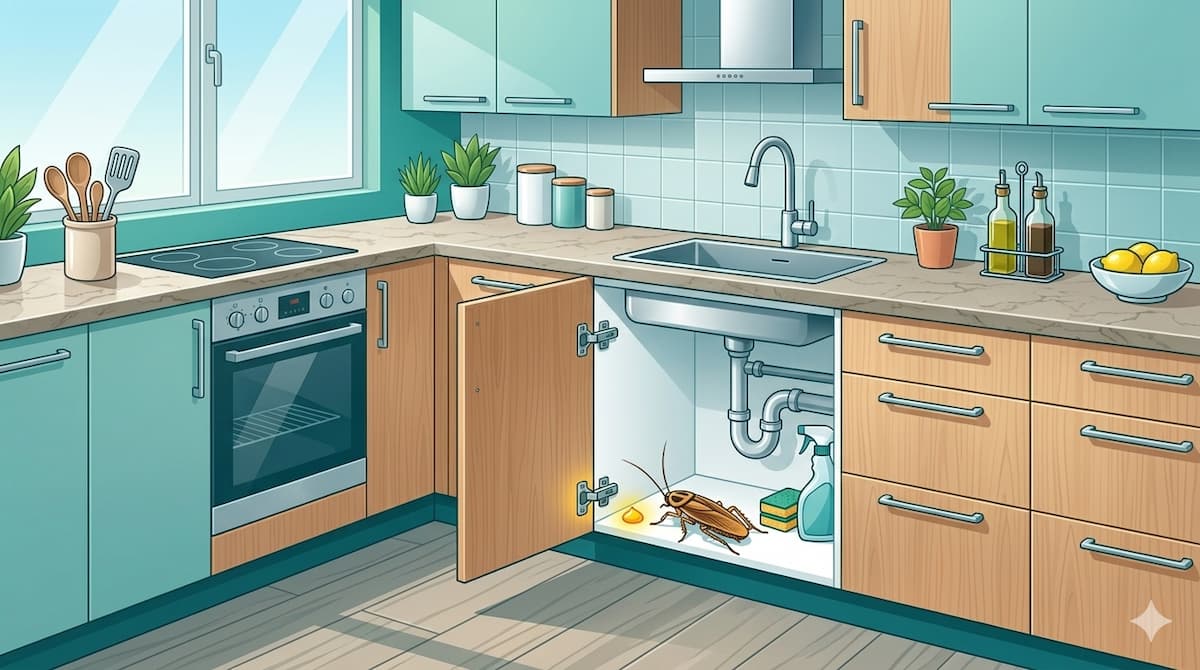
TL;DR: Why do you still see cockroaches after spraying?
If you see a single cockroach, there are usually dozens more hiding deep in cracks, drains, and behind appliances. Traditional aerosol sprays only kill the insects you directly hit, while gel baits like Ultimas Kokron Super Gel are designed to reach deep into the hidden nests. To achieve a truly cockroach-free kitchen, you must combine strict hygiene, physical gap sealing, and strategic gel-bait placement.
Why do cockroaches keep coming back in Indian kitchens?
Many Indian households continuously spray chemical aerosols or physically swat cockroaches, only to find the insects returning within days. This recurring infestation happens because kitchen cockroaches exhibit specific survival behaviors:
- They systematically hide in narrow structural cracks, open drains, and deep inside the housing of warm appliances.
- They preferentially nest in dark, warm, and highly moist micro-environments, such as under the main sink cabinet and behind the refrigerator compressor.
- They are strictly nocturnal foragers, coming out mainly at night to scavenge for food, and immediately retreating to the nest before daylight.
Surface sprays and hit-and-kill methods purely affect the fractional percentage of roaches walking outside at that exact moment. The core breeding colony, safely hidden inside the walls or behind cabinets, remains completely untouched and continues to reproduce.
How big is a “hidden” cockroach infestation?
Professional pest control operators adhere to a fundamental rule of thumb: for every single cockroach you see, at least 10 more are actively hiding. While the exact mathematical ratio varies, it illustrates a critical truth: visible roaches are merely the tip of the pest iceberg.
Critical signs you have a severe hidden infestation:
- Accumulations of small, black, pepper-like droppings heavily concentrated in shelf corners and underneath the sink.
- A distinct, pungent, musty, and oily odor emanating from closed, dark cabinets.
- Hard, pill-shaped egg cases (technically called ootheca) physically glued into wood joints or cracks.
- Roaches actively scavenging during broad daylight (a guaranteed indicator of extremely high population pressure forcing them out of the nest).
Why do normal aerosol sprays fail in modern kitchens?
Traditional aerosol sprays and chalk lines have three major systemic failures when utilized in modern kitchen environments:
- They physically cannot reach the nest: Roaches living deep inside crevices will never come into contact with the superficially sprayed surfaces.
- They create severe contamination risks: Chemical overspray easily settles indiscriminately on food preparation counters, open storage containers, and everyday eating utensils.
- They trigger behavioral avoidance: Over-using the exact same repellent aerosol spray teaches the surviving roaches to fundamentally avoid treated areas, reducing chemical effectiveness over time.
Expert Tip: This is precisely why modern pest professionals now exclusively prioritize targeted gel-baiting inside sensitive food preparation kitchens, relegating aerosol sprays to non-food areas or utilizing them strictly as a final, localized supplement.
How do gel baits like Ultimas Kokron Super Gel actually work?
Unlike repellent sprays, gel baits are chemically engineered to be actively sought out, eaten by cockroaches, and subsequently carried straight back to the hidden nest.
Key operational advantages of gel bait:
- They emit exceptionally low chemical odor and can be applied with pinpoint precision in highly targeted spots.
- Roaches consume the gel voluntarily and unintentionally share the active ingredient (like Fipronil 0.5%) throughout the colony via feeding and physical contact.
- The cascading “domino effect” guarantees that one specifically treated roach possesses the chemical capacity to kill many others.
The Cockroach “Domino Effect” Explained:
- A foraging cockroach locates and ingests a small localized dot of the toxic gel bait.
- The infected cockroach returns to the hidden nest and naturally physically interacts with other colony members.
- Other roaches subsequently feed on the infected roach’s highly toxic droppings, saliva, or the residual gel carried on its legs and body.
- The entire structural colony completely collapses over an agonizing period of days, rather than instantly, continuously spreading the poison.
This biological delayed reaction is exactly why you might still observe sluggish cockroaches for 4-5 days immediately after applying the gel—the product is working systematically inside the colony instead of just rapidly killing the few you can visibly see.
Buy Ultimas Kokron Super Gel (Cockroach killer)
Where exactly should you place gel bait in an Indian kitchen?
Strategic physical placement is exponentially more important than applying a massive volume of gel. Cockroaches inherently prefer to travel strictly along edges, baseboards, and protected structural routes.
High-value strategic spots to place gel bait dots:
- Underneath and directly behind the refrigerator (specifically targeting the warm back panel and the lower base motor).
- Deep inside and underneath the main sink cabinet, focusing heavily around the drainage pipes and dark rear corners.
- Along the internal metal hinges and dark back corners of all lower storage cabinets.
- Proximity targeting near main floor drains, but strictly avoiding direct contact with flowing or pooling water.
- Directly behind heavy heat-generating appliances like microwave ovens, gas stoves, and water purifiers.
Correct Application Method: Apply precise, tiny pea-sized dots roughly every 30–40 cm systematically along edges or directly inside potential hiding cracks. Strictly avoid applying massive continuous lines or oversized blobs—many mathematically spaced small dots are vastly superior.
Hygiene and Sealing: The essential partners to gel-baiting
Even the most technologically advanced Fipronil gel will structurally struggle to eradicate a colony if the kitchen environment simultaneously provides unlimited alternative food sources and secure physical shelter.
Simple Daily Kitchen Hygiene Checklist:
- Strictly refuse to leave dirty, unwashed dishes soaking in the sink overnight.
- Immediately wipe away fresh oil splatters and organic food spills, paying special attention to the often-ignored area underneath the gas stove.
- Aggressively store all raw grains, flours, and loose snacks inside hermetically sealed, airtight containers.
- Religiously empty the organic dustbin every single night and ensure the primary lid remains tightly closed throughout the day.
Structural Sealing Checklist:
- Permanently seal structural gaps around drainage pipes utilizing waterproof silicone caulk or hardened cement.
- Immediately repair or replace broken ceramic tiles where small roaches can readily utilize the voids to hide.
- Professionally install tight metal mesh on exhaust vents and open windows to drastically reduce external entry points.
Comparing Aerosol Sprays vs. Gel Bait for Kitchen Cockroaches
| Control Method | Primary Advantages | Primary Disadvantages | Optimal Use Case Location |
|---|---|---|---|
| Aerosol Spray | Extremely fast visual knockdown of visible roaches. | Completely misses hidden nests; massive chemical contamination risk. | Non-food areas, exterior perimeters, immediate spot emergencies. |
| Gel Bait | Penetrates and systematically destroys hidden colonies; provides long-term control. | Slower visible cessation of roaches; strictly requires correct placement. | Inside kitchens, deep under sinks, inside food pantries and cabinets. |
Essential Kitchen Cockroach Bait Safety Protocols:
- Apply toxic gel bait exclusively in deep cracks and hidden structural voids, never on open, exposed preparation surfaces where raw food is actively handled.
- Keep young children and household pets strictly away from freshly treated baseboards or cabinet hinges until the gel is inaccessible.
- Do not apply gel bait onto excessively hot surfaces (like directly on the stove body) or strictly where it will be washed away by routine wet cleaning.
- Never simultaneously mix or spray chemical aerosols near applied gel bait—the harsh aerosol chemical repellents will actively deter the roaches from voluntarily eating the required gel.
Summary: The professional path to a permanently cockroach-free kitchen
To definitively clear a chronic cockroach infestation from an Indian kitchen environment, you must follow these sequential steps:
- Acknowledge the biological reality that visible roaches unequivocally represent a massive, structurally hidden colony.
- Aggressively improve daily sanitation hygiene and permanently seal critical structural cracks and exterior entry points.
- Completely transition away from indiscriminate spraying and implement highly strategic gel bait placement.
- Maintain absolute patience—expect a slow, gradual, but permanent decline in the visible population over 7–14 days as the internal colony systematically collapses.
- Proactively maintain a negligible amount of fresh gel bait in known high-risk structural spots as a continuous preventive measure.