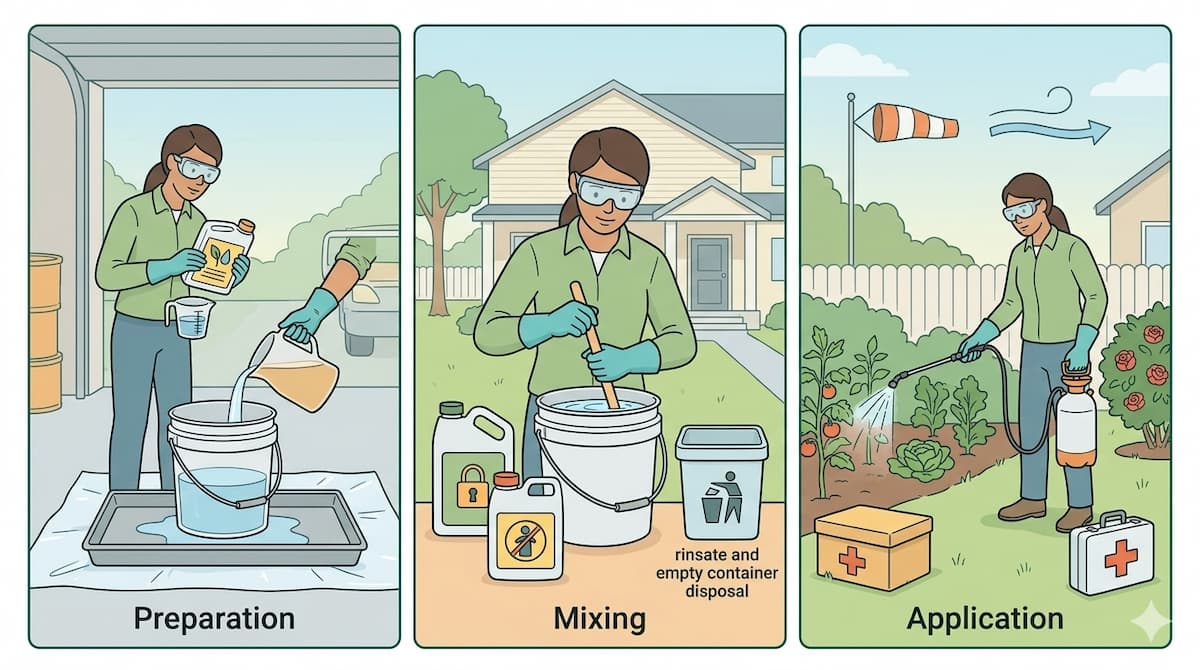
- Read the label first — every product has a specific target crop, dose, spray interval, and pre-harvest interval (PHI). No guessing.
- Wear PPE every time — gloves, mask, long sleeves, and closed shoes. Not optional, even for a “quick spray”.
- Never spray against the wind — always stand upwind so the spray drifts away from you.
- Keep chemicals in original packaging — never transfer into unlabelled bottles, drink containers, or food jars.
- Wash yourself and your tools after every session — skin, face, sprayer, and mixing equipment.
Why Does Pesticide Safety Matter Even in a Small Home Garden?
Many Indian home gardeners assume that pesticide safety protocols apply only to commercial farmers handling large quantities of chemicals. In reality, the risk profile in a small balcony or kitchen garden can be higher — not lower — than on a farm:
- Physical proximity: Home sprayers are typically 30–50 cm from the plants being treated, meaning greater personal exposure than a tractor-mounted boom sprayer. Spray drift lands directly on the gardener.
- Children and pets: Home gardens are shared spaces. Products like Dimethoate 30% EC (TATA Tafgor), Chlorpyriphos 20% EC (Lethal), and pyrethroid-based insecticides are acutely toxic to children, cats, and dogs at much lower doses than to adults.
- Edible crops in close quarters: A balcony garden may have hibiscus next to chilli next to mint. A pesticide applied to an ornamental can drift or drip onto edible crops, creating unintended dietary exposure.
- Misuse risk: Without a label or professional guidance, home gardeners frequently overdose (burning leaves and increasing health risk) or underdose (allowing pests to develop resistance).
The good news: following a small set of consistent rules allows you to safely use professional-grade products like Lethal Chlorpyriphos 20% EC, TATA Tafgor (Dimethoate 30% EC), UPL SAAF (Carbendazim 12% + Mancozeb 63% WP), and Indofil M-45 (Mancozeb 75% WP) in your home and terrace garden — effectively, safely, and without harm to your family or environment.
What Are the “Golden Rules” of Safe Pesticide Mixing and Spraying?
- Read the label before every use — even if you have used the product before. Labels carry dose, approved crops, PHI, first aid, and disposal instructions. The label is the law.
- Wear PPE every single time — gloves, face mask, eye protection, long clothing. No exceptions, even for a small spray job.
- Always stand upwind — position yourself so the spray moves away from your body. If you can smell the product strongly while spraying, you are absorbing it.
- Keep products in their original containers — original packaging has the label, child-warning icons, first aid information, and emergency contact numbers. A transferred product in an unlabelled bottle is a medical emergency waiting to happen.
- Clean up completely — every time — rinse the sprayer, wash your hands and face, and change clothes before re-entering living spaces or handling food.
How to Read a Pesticide Label Before Use
The product label is the most important safety document in your garden shed — and most home gardeners never fully read it. Here is what to check before measuring a single drop:
| Label Section | What to Look For | Why It Matters |
|---|---|---|
| Target pests / diseases | Listed insects, fungi, or bacteria the product is registered for | Using a fungicide for a bacterial disease (or vice versa) wastes money and fails to treat the problem |
| Approved crops | Which vegetables, fruits, or ornamentals are on the label | Some products are not registered for food crops — critical for edible gardens |
| Dose (ml or g per litre) | Exact volume or weight per litre of water | Overdosing burns leaves; underdosing fails to control pests and encourages resistance |
| Spray interval | Minimum days between applications | Spraying more frequently than specified increases residue and resistance risk |
| Pre-Harvest Interval (PHI) | Days to wait after last spray before harvesting and eating | Non-negotiable for edible crops — consuming produce before PHI expires risks chemical ingestion |
| First aid instructions | What to do for skin, eye, inhalation, or ingestion exposure | Critical information that must be accessible immediately in an emergency |
What PPE (Personal Protective Equipment) Do You Need for Home Garden Spraying?
For most home garden applications of pesticides, insecticides, and fungicides, you need the following minimum PPE:
- Gloves: Rubber or nitrile chemical-resistant gloves (not fabric garden gloves — liquid chemicals soak through fabric). Available at any hardware store for ₹50–150 per pair.
- Face mask: At minimum, a cloth mask or surgical mask to prevent inhalation of fine spray mist. For organophosphates like Dimethoate (Tafgor) or Chlorpyriphos (Lethal), an N95/P2 mask provides better protection against fume inhalation.
- Eye protection: Safety goggles or wrap-around sunglasses to prevent spray droplets from reaching eyes. Particularly important when spraying overhead or in wind.
- Clothing: Long-sleeved shirt, full-length trousers, and closed, solid shoes (not sandals or flip-flops). Synthetic fabrics are easier to wash off than natural fibres for most pesticide formulations.
The most common cause of accidental pesticide exposure in home gardens is taking shortcuts for “just a small spray”. It only takes 30 seconds to put on gloves and a mask — but it takes days to weeks for organophosphate exposure symptoms to fully resolve. Treat every spray session, however brief, as requiring full PPE. No exceptions.
How to Mix Pesticides Correctly at Home: Step-by-Step
Correct mixing technique ensures accurate dosing, product stability, and safety. Follow this sequence for any liquid (EC/SL) or wettable powder (WP/SP) formulation:
-
Choose your mixing area.
Mix outdoors or in a well-ventilated covered area only. Keep mixing well away from children, pets, food, cooking areas, and drinking water supplies. -
Put on full PPE before opening the product.
Gloves and mask go on before uncapping the bottle — not after. The highest exposure moment is often the initial opening and pour. -
Fill the sprayer tank or bucket halfway with clean water first.
Never add water to concentrated chemical — always add chemical to water. This reduces the risk of splashing concentrated solution. -
Measure the pesticide accurately.
Use a dedicated syringe (for liquids in ml) or digital kitchen scale (for powders in grams). Never estimate “by eye”. Measure into a small cup first, then pour into the tank — never pour directly from the product bottle into the tank without measuring. -
Add chemical to water, not water to chemical.
Pour the measured product gently into the half-filled tank. Stir or swirl to disperse it. -
Top up with water to the final required volume.
Stir or agitate well one more time before spraying. For WP formulations (like Mancozeb or SAAF), shake the sprayer tank every few minutes during application to prevent settling. -
Label your mixing container.
If you prepare a tank and don’t use all of it immediately, write the product name and date on the tank with a marker. Never leave unmixed concentrate in ambiguous unlabelled containers.
How to Spray Pesticides Safely in a Home Garden
Before You Start Spraying
- Check the wind direction — always position yourself upwind of the plants you are spraying.
- Move children, pets, and birds (including caged birds) completely out of the area before starting. Do not spray near fish tanks or ornamental ponds.
- Close windows and doors of adjacent living spaces to prevent spray drift indoors.
- Check the weather — avoid spraying within 4 hours of expected rain (product washes off) or during wind gusts above 15 km/h.
Timing Your Spray Sessions
- Best window: Early morning (6–9 AM) or late evening (5–7 PM) — temperatures are lower, wind is typically calmer, and beneficial insects (bees) are less active.
- Avoid: Midday during Indian summer heat above 35°C — hot leaves absorb chemicals unevenly and phytotoxicity risk increases significantly.
- Avoid: Spraying directly on open flowers during daylight hours when bees are foraging — most insecticides are toxic to pollinators.
While Spraying
- Do not eat, drink, smoke, touch your face, or use your mobile phone during spraying.
- Maintain a consistent distance from the plant — 30–50 cm for hand sprayers — and use a sweeping motion for even coverage.
- Cover leaf undersides and stem joints, not just the visible top surface — most pests and fungal spores concentrate on undersides.
- If the tank runs out mid-application, treat the unused area immediately after refilling — do not leave part of a plant untreated and return hours later.
Immediately After Spraying
- Triple-rinse the sprayer tank with clean water. Pour rinse water into a designated drain or an area away from vegetable beds, water sources, and play areas.
- Wash both hands, forearms, and face thoroughly with soap and water.
- Remove and wash all clothing worn during spraying before wearing again.
- Store the sealed product in a cool, dry, locked location immediately.
How to Measure 2 ml/L or 2 g/L Without Professional Tools
Most home garden pesticides are dosed at 1–2 ml per litre (liquids) or 1–2 g per litre (powders). Here are practical measurement solutions for home gardeners:
| Tool | How to Measure 2 ml (per 1 L) | How to Measure 10 ml (per 5 L) | Accuracy |
|---|---|---|---|
| 5 ml disposable syringe (without needle) | Draw to the 2 ml graduation mark | Two full 5 ml draws | ⭐⭐⭐⭐⭐ Most accurate — recommended |
| Digital kitchen scale | For powders: zero the scale, weigh 2 g directly | For powders: weigh 10 g directly | ⭐⭐⭐⭐⭐ Most accurate for WP/SP powders |
| Marked bottle cap (5 ml cap) | Fill just under half a 5 ml cap | Two full 5 ml caps | ⭐⭐⭐ Acceptable approximation |
| 5 ml teaspoon (dedicated-only) | Slightly under half a level teaspoon | Two level teaspoons | ⭐⭐ Volume ≠ weight for powders; use only as rough guide |
| Guessing by eye | — | — | ❌ Never acceptable — do not guess doses |
A pack of 5 ml disposable syringes (without needle) costs ₹10–30 at any pharmacy. Label it “PESTICIDE USE ONLY” with a permanent marker and store it with your garden chemicals. It eliminates measurement guesswork for every liquid product you ever buy — Tafgor, Monocil, Lethal EC, and any future product. Never use the same syringe for medicine or food use.
How to Store and Dispose of Pesticides Safely at Home
Storage Rules
- Store all pesticides in a cool, dry, well-ventilated location away from direct sunlight — heat and UV degrade most formulations and can cause pressure build-up in sealed containers.
- Keep products in a locked cabinet or a dedicated shelf that children cannot access. A simple padlocked metal cabinet is ideal.
- Store chemicals away from food, water, animal feed, and medicines — even closed containers can outgas trace fumes.
- Always close caps tightly immediately after measuring — even partial evaporation of ECs (emulsifiable concentrates) like Tafgor or Lethal changes the concentration ratio.
- Do not store products on very high shelves where accidental drops could cause spills and exposure.
Disposal Rules
- Never pour leftover diluted spray solution down kitchen or bathroom drains — organophosphates and pyrethoids are harmful to aquatic organisms in sewage systems.
- Leftover diluted solution can be applied to non-edible ornamental soil in a diluted form — check the product label for guidance.
- Empty pesticide containers should be triple-rinsed with water, then punctured or crushed to prevent reuse, and disposed of via local municipal solid waste following container disposal instructions on the label.
- Never burn empty pesticide containers — combustion of organophosphates and pyrethroids releases toxic fumes.
What to Do in Case of Accidental Pesticide Exposure
Act immediately. Do not wait for symptoms to develop before taking action — many organophosphate and pyrethroid symptoms have a delay of 30–90 minutes between exposure and visible onset.
| Type of Exposure | Immediate Action | Medical Action |
|---|---|---|
| Skin contact | Remove contaminated clothing immediately. Wash affected skin with generous amounts of soap and water for at least 15 minutes. | Seek medical advice if irritation, redness, or numbness persists after washing. |
| Eye exposure | Rinse eyes gently with a continuous stream of clean water for at least 15–20 minutes. Remove contact lenses if present before rinsing. | See a doctor or go to emergency — even if eyes feel better after rinsing, chemical damage can be delayed. |
| Inhalation | Move the person to fresh air immediately. Loosen tight clothing. Rest in a seated, upright position. | Call emergency services if breathing is difficult, the person is confused, or symptoms do not resolve within 10 minutes in fresh air. |
| Ingestion | Do NOT induce vomiting unless specifically directed by a doctor. Give water to drink if the person is conscious and alert. | Call Poison Control or go to emergency immediately. Bring the original product label or bottle — medical staff need the active ingredient name for treatment. |
- National Poison Information Centre (AIIMS, New Delhi): 1800-11-6117 (toll-free) or 011-26593677
- Local Emergency: 112 (national emergency number)
- Keep the original product label accessible — always bring it to the hospital. The active ingredient name determines treatment. “Pesticide” is not specific enough for medical staff.
Complete Safe Spraying Checklist for Home Gardeners
- Before you start: Read the full product label. Confirm the product is registered for your target pest and crop. Check the PHI for any edible plants in the area.
- PPE: Chemical-resistant rubber or nitrile gloves, P2/N95 mask or respirator, wrap-around eye protection, long-sleeved shirt, full-length trousers, and closed shoes. All PPE on before opening the product.
- Ventilation: Mix and spray outdoors or in well-ventilated spaces only. Never in enclosed rooms, kitchens, or near air intake vents.
- Children and pets: Remove completely from the spray area before starting. Do not allow re-entry for at least 24–48 hours or until all surfaces are dry.
- Wildlife and water: Keep products away from ponds, fish tanks, bird water bowls, and all drainage that leads to natural water bodies.
- Pollinators: Spray early morning or evening only. Do not spray on flowering plants when pollinators are actively foraging.
- Food crops: Strictly observe the pre-harvest interval (PHI) on the label before consuming any produce from treated plants.
- After spraying: Triple-rinse the sprayer. Wash hands, face, and all skin with soap and water. Change clothes before entering living spaces or preparing food.
- Storage: Sealed in original packaging, in a cool dry locked space, away from all food, water, medicines, and children.
- Emergencies: Keep the product label accessible and take it to the hospital in case of accidental ingestion or severe exposure.
Products Used in Indian Home Gardens — Shop Safely
These are the professional-grade products referenced throughout this guide, available at AgriHome with full product labels and safety information:
Buy TATA Tafgor (Dimethoate 30% EC)
Buy Lethal (Chlorpyriphos 20% EC)
Buy UPL SAAF (Carbendazim + Mancozeb)
Buy Indofil M-45 (Mancozeb 75% WP)
Frequently Asked Questions About Pesticide Safety for Home Gardens
Can I mix two different pesticides in one sprayer tank?
Tank-mixing is possible, but not all combinations are compatible or safe. Before mixing two products, check: (1) both product labels allow tank-mixing, (2) the products are from different chemical classes to reduce resistance risk, (3) conduct a small 50 ml compatibility test — if the mix separates, precipitates, or produces heat, do not use it. Never mix without confirming compatibility: some combinations can cause phytotoxicity or reduce the efficacy of both products.
What happens if I accidentally overdose — use too much pesticide per litre?
Overdosing causes two problems: phytotoxicity (chemical burn damage to leaves, appearing as brown tips, scorched patches, or complete leaf death) and increased chemical residue on edible crops, extending the safe eating interval. If you accidentally over-concentrate a mix and have already sprayed, flush the treated plants with clean water within 30 minutes of application if possible. Do not eat treated produce until at least double the standard PHI has elapsed.
Do I need PPE for fungicides like SAAF or Indofil M-45, or just for insecticides?
Yes, PPE is required for all pesticide categories — fungicides, insecticides, herbicides, and plant antibiotics. Fungicide wettable powders like Mancozeb 75% WP (Indofil M-45) and Carbendazim + Mancozeb (UPL SAAF) are fine airborne powders during mixing: inhalation of fungicide dust during the mixing stage poses a real respiratory risk. Gloves and a mask are non-negotiable even for fungicides.
How long should I keep children and pets away after spraying?
As a general rule, keep children and pets away for a minimum of 24–48 hours after application, or until all treated surfaces are completely dry to the touch. For organophosphate products like Dimethoate (Tafgor) or Chlorpyriphos (Lethal), the 48-hour minimum is strongly recommended due to their higher acute toxicity to children and cats. Always verify the specific re-entry interval on the product label — some products have shorter documented intervals.
Can I pour leftover diluted spray solution down the sink or drain?
No. Most insecticides (organophosphates, pyrethroids) and fungicides are harmful to aquatic invertebrates and fish at very low concentrations. Pour leftover spray solution onto a non-food patch of garden soil (not near water), or apply it to the ornamental plants it was intended for. Never pour down kitchen sinks, bathroom drains, stormwater grates, or anywhere that leads to natural waterways.
Conclusion: Safe Gardeners Are Effective Gardeners
Pesticide safety in a home garden is not about fear — it is about competence. Understanding what you are applying, why the label dose exists, and how to protect yourself and your family while applying it transforms you from a reactive sprayer into a skilled, responsible home gardener.
The products available to Indian home gardeners today — Lethal Chlorpyriphos 20% EC, TATA Tafgor Dimethoate 30% EC, UPL SAAF, Indofil M-45 Mancozeb 75% WP — are genuinely professional-grade tools. Used correctly, with the right measurement, the right PPE, and the right timing, they are safe and highly effective. Used carelessly, any chemical — even water — becomes a hazard.
Print this guide. Keep a 5 ml syringe in your garden kit. Store chemicals in a locked cabinet. Read every label. Those four habits alone will make your garden safer and your pest and disease control more effective season after season.